

Welcome to the fourth edition of my series on Business Central Document Dates where I will be focusing on all things dates relating to the Assembly Order document. This is a follow up to my edition on Transfer Order dates which can be found here.
Clients often ask me what the various document date fields across transactional documents mean and how they interact with other dates. Or I come across some very creative uses of existing date fields. Whilst it might be tempting to adopt the use of one of the “other” date fields you may not currently be utilising, I can assure you they all serve a unique purpose.
Over the coming months I will be releasing a series of articles around the Dynamics 365 Business Central Document Dates, which started with Purchase Orders. I hope to dispel some of the ambiguity of the date fields across all documents. In the next installment we’ll take a look at Production Order dates.
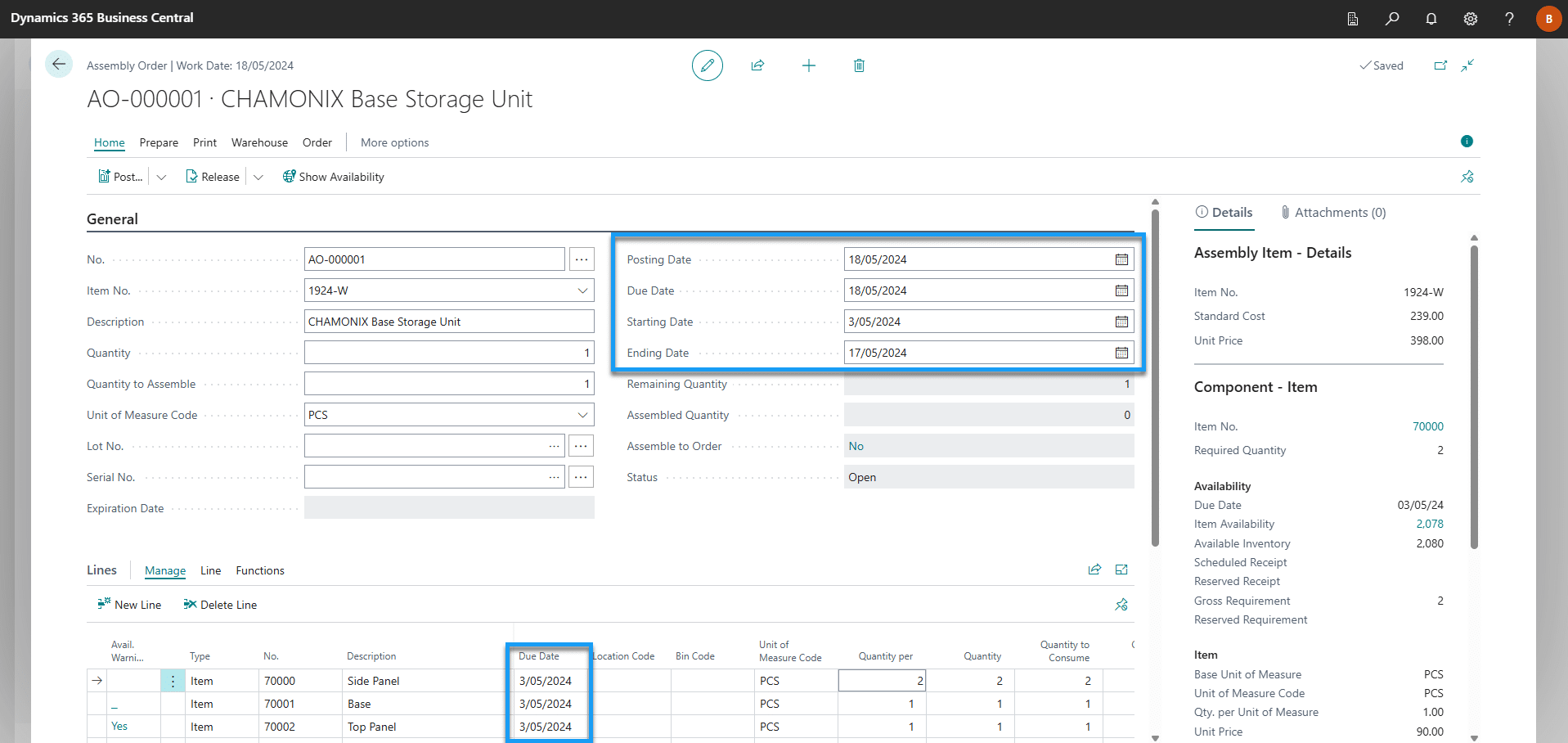
Assembly Order Dates
Posting Date
Specified the date that will be attributed to ledger entries posted from the order.
Starting Date
Specifies the date that assembly should start in order to output an assembled item by the Due Date.
Ending Date - Lead Time Calculation = Starting Date
Ending Date
Specifies the date that the assembly should finish. The assembled item is expected to be output to inventory at this point (not necessarily available on inventory for the demand event depending on safety lead time and warehouse handling setup).
Document Date + Due Date calculation = Due Date
Due Date (Assembly Order)
Specifies the date that the output assembled item is expected to be available on inventory to supply a demand event (such as a sale or transfer order).
This date is updated indirectly when you change the Starting Date due to the Starting Date’s effect on Ending Date (except when the Assembly Order is linked to a Sales Order in an assemble-to-order scenario).
If the Assembly order is linked to a Sales Order the Due Date will be the same as the Shipment Date on the linked Sales Order.
Ending Date + Safety Lead Time + Inbound Whse. Handling Time = Due Date
Due Date (Assembly Line)
Specifies the date that the assembly component is expected to be available to supply the demand event attributed to the sub-assembly or assembled item for the same Assembly Order.
Due Date of preceding component* + Lead-Time Offset = Due Date (Assembly Line)
*Due date of preceding component is a concept rather than a field. The preceding component is measured using the “position” field from the starting date with the last component to be consumed by the ending date.
FAQs
- Determines the date used for ledger entries when the order is posted
- Impacts inventory valuation and financial reporting
- Indicates when assembly should begin
- Calculated to help ensure completion by the Due Date
- Indicates when assembly is expected to finish
- Marks when the assembled item is output to inventory
- Specifies when the finished item is expected to be available in inventory
- Used to satisfy demand such as sales or transfer orders
- Ending Date = assembly completion
- Due Date = when the item is actually available for use after lead times or warehouse handling
- Indicates when a component must be available
- Helps ensure parts are ready for the parent assembly
- Drive scheduling and material planning
- Influence inventory availability and demand fulfillment
- Incorrect dates can cause shortages or delays
- Not recommended
- Each date field serves a specific planning and operational purpose
- Misuse can create reporting and supply chain issues
- Financial posting may occur in a different period
- Operational availability may not align with accounting dates
- Additional warehouse processing can delay item availability
- Safety lead times may also impact final availability dates
- Yes, Assembly Orders are often linked to a Sales Order in an Assemble-to Order scenario
- In an Assemble-to Stock scenario however they are not linked but requirement is driven by Sales or Transfer demand.
- Use each date field for its intended purpose
- Maintain accurate lead times and planning settings
- Regularly review scheduling and inventory processes
- Assembly Orders support simpler structure with a simple list of components.
- Production Orders are designed for more advanced manufacturing with multi step routing, multi level bill of material and capacity planning in Microsoft Dynamics 365 Business Central