

Overview
The Dynamics 365 Business Central 2026 release wave 1 plan covers all new functionalities planned to be delivered to market from April 2026 to September 2026.
Release Wave 1 2026 (version 28) continues Microsoft’s move toward an AI-driven ERP. The focus is on embedding Copilot and AI agents into everyday processes, strengthening governance, and delivering tangible performance and usability improvements across finance and operations.
Copilot & AI Agents
Business Central continues to evolve into an agent-driven ERP, where AI actively supports users rather than simply providing suggestions.
Key themes include:
- Expansion of built-in AI agents that automate end-to-end processes directly within Business Central.
- Clear visibility and control over AI activity, helping users trust and supervise automated actions.
- Reduced reliance on manual email and document processing for finance and sales teams.
Payables Agent & Sales Order Agent Improvements
Enhancements focus on making these agents more usable in real-world scenarios:
- Clear indication of emails already processed by the Payables Agent, especially valuable for shared inboxes.
- Improved email categorisation to ensure items reach the right users.
- Ability to manage or stop agent tasks via a dedicated task pane.
Dedicated Agent Task Pane & Record-Level Visibility
Users can now:
- View all agent-generated tasks from a central location.
- Review AI-generated content directly on the relevant records.
- Maintain governance and auditability while benefiting from automation.
Finance & Operations
AI-Assisted Insights for Items & Inventory
New AI-powered item insights surface key performance indicators directly on item statistics, including inventory valuation and sales performance metrics. This reduces the need for external analysis and speeds up decision-making.
Stronger Approval Workflows & Governance
Approval capabilities have been extended to cover:
- Item and physical inventory journals
- Consumption and output journals
- Requisition and planning worksheets
These controls help strengthen separation of duties and improve audit readiness as organisations grow.
Easier posting period maintenance
Posting periods no longer need to be fixed, and can be setup using date formulas to calculate the allowed date range based on the current date.
| Scenario | Allow posting from date formula | Allow Posting To Date Formula | Work date | Resulting Range |
| Current month only | -CM | CM | Mar 17, 2026 | Mar 1 – Mar 31 |
| Rolling 30-day window | -30D | 0D | Mar 17, 2026 | Feb 15 – Mar 17 |
| One month back, one week forward | -1M | 1W | Mar 17, 2026 | Feb 17 – Mar 24 |
| Previous month close | -1M -CM | -CM -1D | Mar 17, 2026 | Feb 1 – Feb 28 |
| Today only | 0D | 0D | Mar 17, 2026 | Mar 17 – Mar 17 |
Drop Shipment Improvements
Changes to drop shipment functionality improves existing capability and increases ease of use:
- A new purchase order can be created directly from the related sales order
- Undo shipment & receipt can be used to easily reverse drop shipments, if the source documents aren’t yet invoiced
- Purchase & sales invoices can be posted independently to allow for more flexible payment obligations
Purchase Invoices
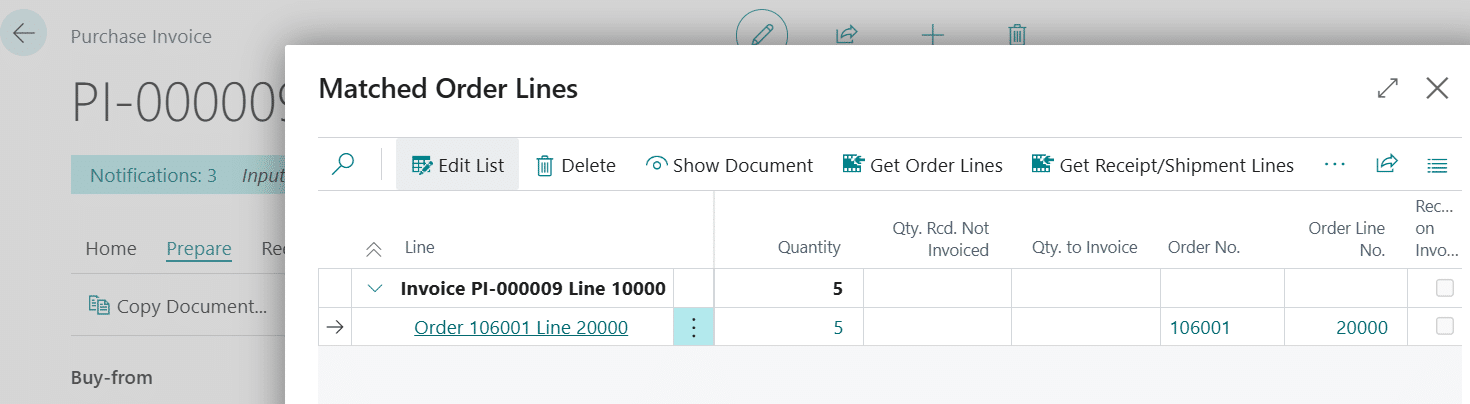
Purchase invoices can now be matched with not just posted receipt lines but also purchase order lines too. This streamlines the accounts payable process, allowing the user to post the related purchase receipt automatically as it’s invoiced.
Quality Management Enhancements
Native quality management capabilities have been extended across purchasing, production, and assembly processes:
- Create quality tests – quality checks can now be performed at the lot, serial or package level. Multiple tests are grouped into a template which acts as the test plan for an item.
- Define inspection rules – configure quality tests to be conducted for specific inventory workflows, and define allowed values and test pass conditions.
- Quarantine inventory – while quality tests are not yet passed, allow the inventory to be managed internally (i.e. purchases, put-aways & movements), while preventing the inventory from further processing (i.e. production consumption, sales & picks).
Performance, Reliability, & Platform Improvements
Performance Optimisation
Microsoft continues to invest in platform-level optimisation, including:
- Reduced table locking during posting
- More efficient SQL execution patterns
- Improved scalability for higher transaction volumes
Search & Usability Enhancements
Users benefit from faster navigation and improved data discovery through:
- Optimised text search in lists
- Foundations for semantic and relevance-based search
- More efficient FlowField calculation behaviour
Governance, Security, & Administration
Administrators gain better visibility and control through:
- Centralised permission reporting across apps and extensions
- More secure defaults for external communications
- Improved tooling to understand and manage extension behaviour
Development & Extensibility
Version 28 introduces significant improvements for developers and partners, including:
- Better testing and benchmarking tools
- Improved support for AI-enabled extensions
- Enhancements aimed at reducing upgrade effort and extension risk
These changes support long-term platform stability and faster adoption of new functionality.